Lidl uses driverless truck to deliver to stores in Germany
Lidl has started using a cabless autonomous electric truck for regular store deliveries in Germany, assigning it a daily replenishment route between its Edermünde distribution center and a nearby store.
The truck, supplied by Swedish transport technology company Einride, operates at SAE level 4 with a permit from the German Federal Motor Transport Authority (KBA).
The vehicle operates without a driver or safety operator on board. Einride and Lidl claim that KBA’s permit is the first of its kind in Germany for a level 4 truck without a cab operating as part of daily logistics.
Autonomous truck enters daily resupply
The truck has space for 15 euro pallets and can make up to three trips a day. Lidl said it will cover all dry goods deliveries on the designated route during the four-month project.
The vehicle can move more than 3,000 pallets during that period. “With this innovative project, we are testing a technological milestone step by step and safely in real-world operations,” said Thomas Dangelmayer, Head of Operational Logistics at Lidl Germany.
Lidl is using the project to evaluate how autonomous transport can be incorporated into its existing logistics operations. Its September 15 announcement did not provide figures on cost savings, delivery times, vehicle utilization or productivity gains, and the retailer has not announced a broader rollout as part of the current rollout.
Lidl and Einride have also linked the project to the shortage of drivers and the continuity of freight movements. The International Road Transport Union estimated in June 2026 that around 502,000 truck driver positions were vacant across Europe in 2025, representing 13% of positions in the markets covered by its survey.
IRU expects around 20% of Europe’s current driver workforce to retire within five years. About two-thirds of European operators surveyed also said they had turned down new contracts because they could not find enough drivers.
How Germany allows level 4 cargo operations
SAE International classifies Level 4 as high driving automation. At this level, the automated driving system can perform the driving task without requiring a human to take control when operating within the conditions for which the system was designed.
Level 4 remains limited to specific operating conditions, unlike Level 5, which SAE defines as full driving automation under all conditions. Germany allows Level 4 driverless vehicles to operate on public roads within approved operating areas.
Germany’s Autonomous Driving Act came into force in July 2021 and established a legal framework for Level 4 vehicles to operate on public roads beyond testing. The Federal Ministry of Transport stated that vehicles must remain within geographically defined operational areas.
The KBA is responsible for the approval of vehicles with autonomous driving functions, while the competent state authority or, in the case of national roads, Autobahn GmbH, authorizes the area of operation.
German standards maintain human technical supervision even when no driver is physically inside the vehicle. A technical supervisor can disable the vehicle or approve certain maneuvers when the automated system requires intervention, but the law does not require that the vehicle be permanently monitored while driving autonomously.
The vehicle must also be able to enter a minimal risk state if it reaches its system limits or cannot continue to operate as intended. German law defines it as stopping the vehicle in the safest place available and activating the emergency lights.
Einride says its autonomous driving stack combines machine learning-based navigation with an independent deterministic safety verifier. The system uses a redundant sensor suite consisting of lidar, radar and cameras, and testing is carried out through simulation, hardware and vehicle-in-the-loop testing, proving grounds and site validation prior to deployment.
Parts of Einride’s autonomous technology have been subject to external review. Swedish research institute RISE said it reviewed the functional safety of the company’s control system, including obstacle detection and cybersecurity, as part of Einride’s application for autonomous vehicle testing on Swedish public roads in 2025.
That review concerned Einride’s broader autonomous system rather than Lidl’s German rollout. Einride also said in May 2026 that TÜV SÜD had initiated an independent assessment of the governance processes behind its autonomous safety management system.
From one delivery route to a multi-stop model
Lidl’s current operation connects the Edermünde distribution center with a nearby store. Following successful validation of the route, Lidl plans to expand the approach through a multi-stop “milkrun” model elsewhere.
A milkrun combines multiple pickup or drop-off points on a scheduled route. In the case of Lidl, the planned phase would take autonomous operation beyond the current single connection between the distribution center and the store.
Lidl operates more than 3,250 stores and 39 administrative and distribution centers in Germany. The company has not said that autonomous vehicles will be deployed across that broader network.
Einride previously moved autonomous truck transportation from a public road pilot to recurring logistics operations with GE Appliances in Tennessee. The companies conducted a two-week pilot on public roads in 2022 before putting an autonomous vehicle into full-time daily operations in November 2023.
The GE Appliances operation was scheduled to make up to seven trips per day transporting finished products between a factory and a warehouse. AI-enabled cameras were used to operate dock equipment, while an autonomous mobile robot loaded and unloaded the truck, reducing loading times by 80%, according to GE Appliances.
GE Appliances said the implementation was designed to link multiple automation systems within the same logistics flow. “We are moving from implementing single solutions that address diverse challenges to creating interoperability between systems,” said Harry Chase, senior director of core materials at GE Appliances.
An Einride remote operator remained on scene to monitor the GE Appliances vehicle. Lidl’s deployment in Germany differs in using the country’s Level 4 framework for driverless operations on public roads within a defined operational area.
Lidl and Einride said further autonomous implementations are being discussed with other Schwarz Group companies. The companies have not announced a timeline or vehicle count for those deployments.
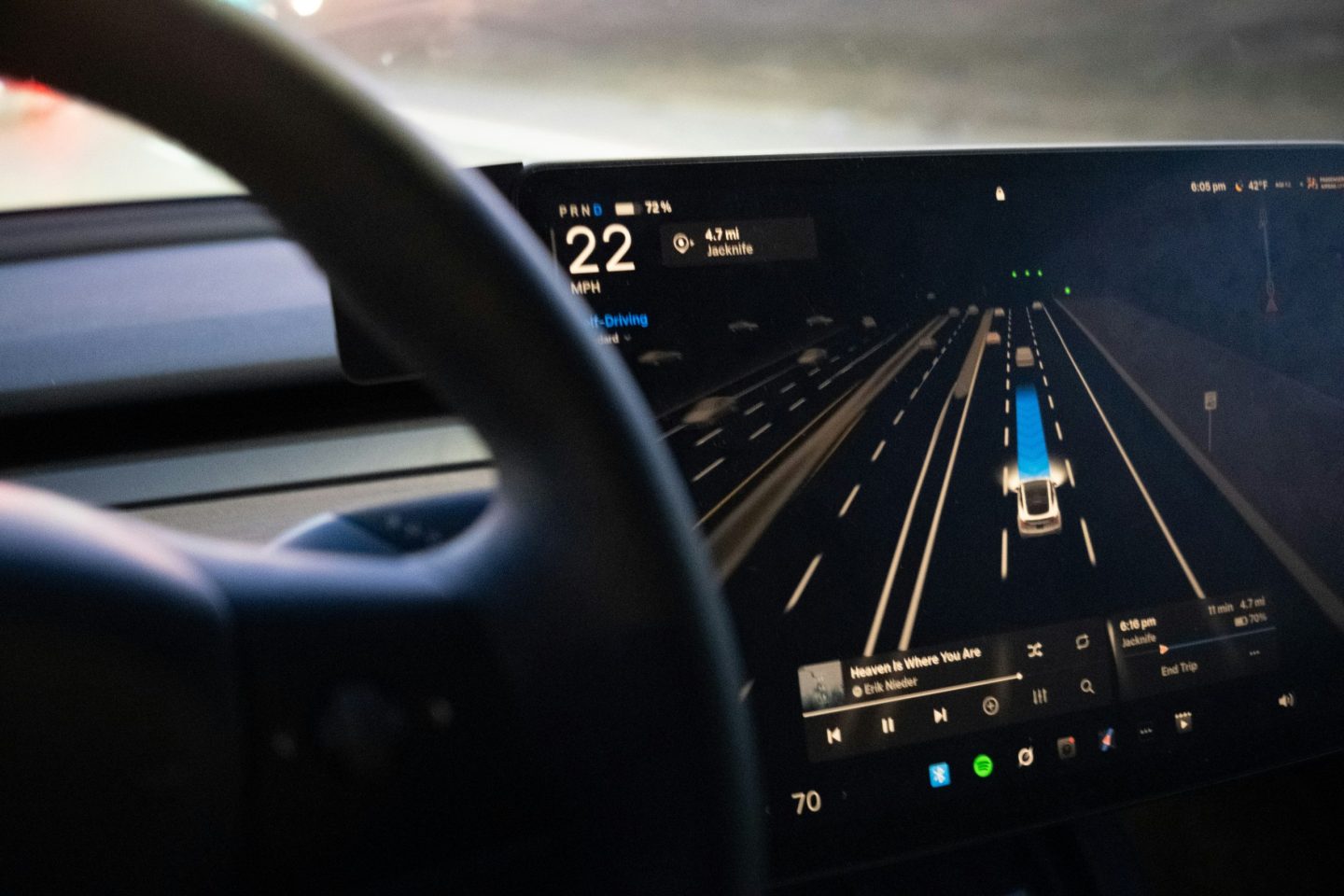
(Photo by Josh Sorenson)
See also: JD.com expands physical AI in logistics with 3 million robots
Want to learn more about AI and big data from industry leaders? Check out the AI & Big Data Expo taking place in Amsterdam, California and London. The comprehensive event is part of TechEx and is co-located with other leading technology events, including Cyber Security & Cloud Expo. Click here for more information.
AI News is powered by TechForge Media. Explore other upcoming enterprise technology events and webinars here.












Post Comment