Boston Dynamics adds wheels to humanoid Atlas to test full-body control
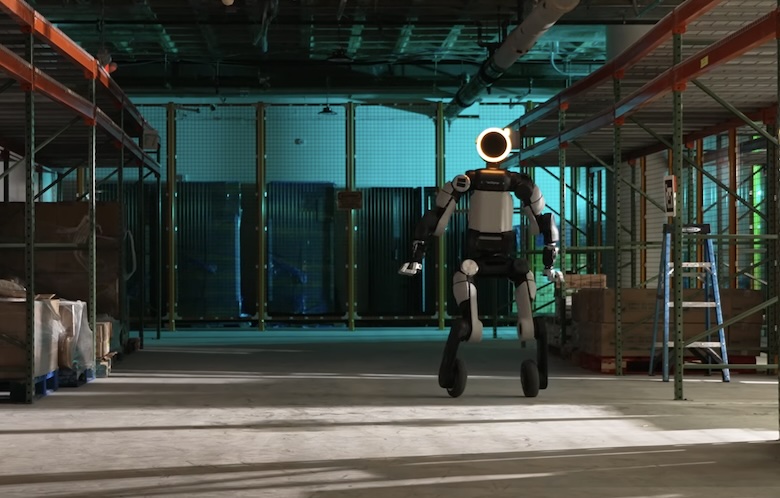
Bridging the gap between physics-based deterministic control and policy-driven adaptation, Boston Dynamics today released a video showing its humanoid Atlas using wheels to get around. The “experiment” combined classical model-based motor control with whole-body reinforcement learning to maintain dynamic stability on unstructured real-world terrain.
In the video, Andy Wu, controls engineer for Atlas at Boston Dynamics, highlights some recent experiments he performed attaching wheels to Atlas’ legs. Boston Dynamics stated that “an Atlas on wheels is not a product. It is a research test bed.” Wu’s intention was to push implementation to the limit.
Another goal of the experiment was to understand the adaptability of the unstructured environment. Wu addresses the limitations of purely model-based control when dealing with unpredictable real-world conditions that are difficult to model or simulate.
Through a full-body reinforcement learning (RL) policy, Atlas demonstrates its ability to process proprioceptive feedback and velocity commands in real time. The experiment also produces dynamic poses and force adjustments to mitigate non-modeled disturbances and non-ideal contact states.
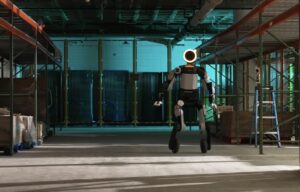
Boston Dynamics attached wheels to the feet of the humanoid Atlas for a series of control engineering experiments. | Credit: Boston Dynamics
Atlas moves like a skater
In addition to learning to move with wheels instead of feet, Atlas also performs pirouettes and various aggressive actuation maneuvers.
This shows that Atlas can smoothly transition from rolling quickly on flat ground to moving its articulated legs over obstacles or uneven surfaces.
Wu trained the system in simulation. According to Wu, the system learned all the behaviors in simulation and executed them in real life, with surprising accuracy.
Wu said converting Atlas’ locomotion style was “wonderfully simple.” A single custom adapter mounts a standard scooter rim to Atlas’ existing ankle actuator, and that’s the only new part in the entire build. Because Atlas was designed from the beginning to be produced in high volumes and to be easy to maintain, Wu said the retrofit was about as complicated as changing a wheel on a bicycle.
The software side was equally simple, he said. Each wheel is modeled as an “ankle” that can continuously spin, so all Wu had to do was take the basic model of the robot and replace the feet with wheels.
Real-world implications for humanoid operations
The next question Wu plans to answer is the policy response to failed implementers. This is key to safety and understanding how the system will respond to a system failure.
The main goal for Wu and the control engineering team at Boston Dynamics is to understand control synergy. The video demonstrates that combining classical motor controls (for basic stability) with whole-body RL (for reactive adaptation) produces superior real-world agility compared to using either method alone.
The debate over wheels versus legs continues
Boston Dynamics’ latest Atlas experiment adds another interesting fact to the ongoing debate about wheels versus legs in humanoid robotics. While many companies are developing humanoids on wheels, others are turning to legs to navigate environments designed for people.
Agility Robotics recently said it is also exploring wheeled robots as part of a larger family of human-centric multipurpose platforms. Co-founder and Chief Robot Officer Jonathan Hurst said the Digit likely won’t have wheels, but the company is exploring other wheeled configurations.
Once again, Boston Dynamics said that an Atlas on wheels is a research testbed, not a product. However, experiments like this raise an interesting question about how much of the humanoid form factor needs to be human-like to be commercially useful. We’ll be watching to see where the industry goes next.
The experiments come as Boston Dynamics prepares to ramp up Atlas testing at Hyundai facilities and continues to develop the humanoid’s capabilities, including its new four-fingered gripper. The robot report we will observe how these developments translate into real-world implementations.
Propose your innovation now!








Post Comment