Nozomi Networks brings AI Security Cloud to FedRAMP Moderate – Unite.AI
Nozomi Networks announced on November 9, 2026, that Vantage for Government achieved Moderate certification under the Federal Risk and Authorization Management Program (FedRAMP), offering federal agencies a certified cloud option for securing artificial intelligence-assisted (OT) and Internet of Things (IoT) operational technology.
The FedRAMP Marketplace lists the service as certified as of November 5, 2026 and places it in the ongoing certification phase for continuous steady-state monitoring and reporting. Its profile uses the agency path of review 5 in Class C (moderate), with software as a service deployment in a government community cloud.
The certification advances the platform from the In Process designation announced by Nozomi on October 23, 2025. The Moderate designation addresses serious potential harm to an agency’s operations, resources, or people in the event of a loss of confidentiality, integrity, or availability of a cloud service.
How AI supports OT and IoT security
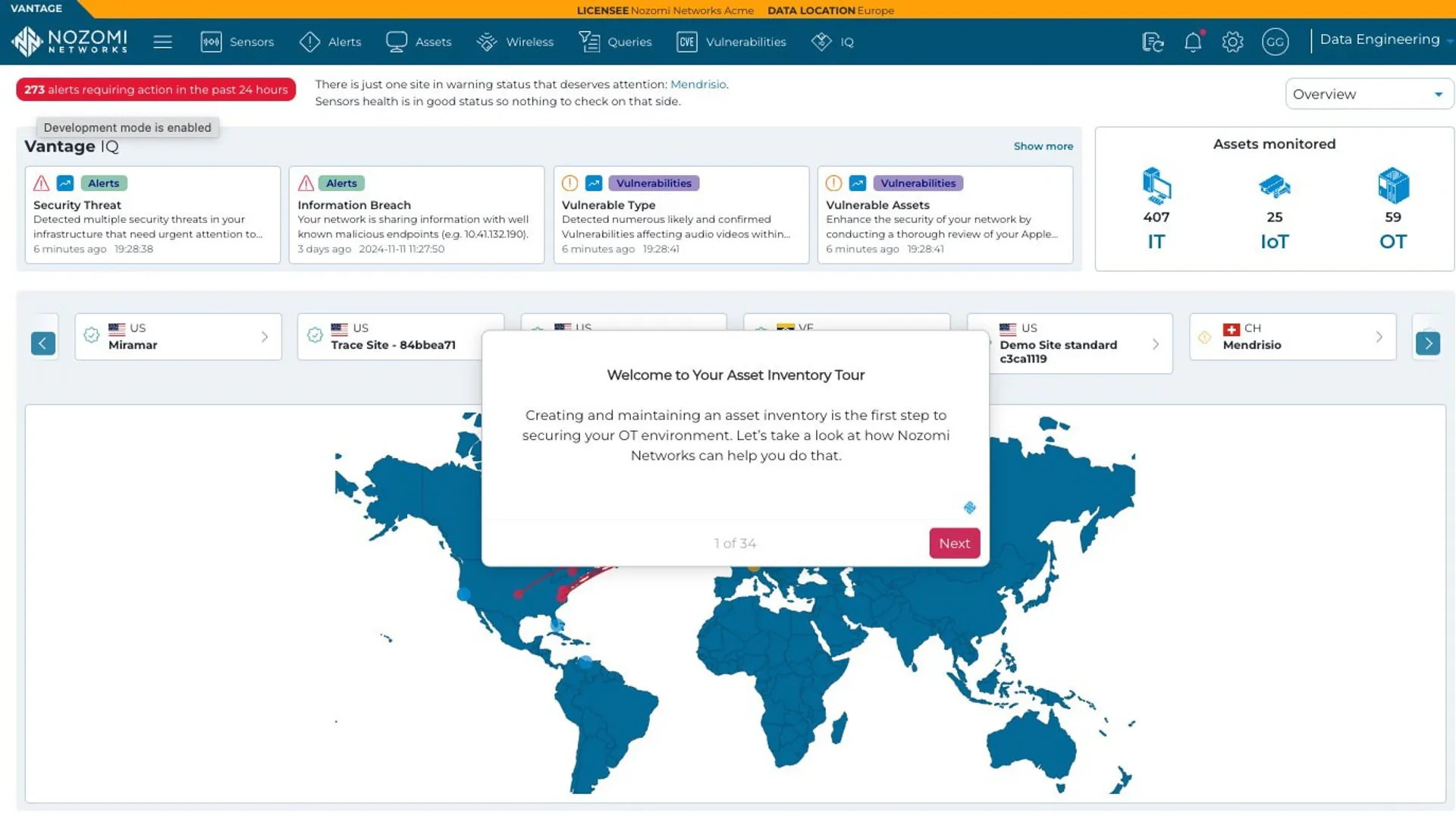
Nozomi says Vantage for Government centralizes the management of OT and IoT security sensors in environments that can also include IT systems. Asset discovery relies on passive and active collection as well as host-based data, then uses artificial intelligence to enrich inventory information across wired, wireless, and endpoint environments. The vulnerability workflow avoids intrusive scans and ranks fixes based on exploitability and operational impact, with the goal of reducing interruptions and scanner noise associated with IT-centric tools.
In the service description submitted by the vendor, which FedRAMP does not review or endorse, Nozomi describes detection that continuously inspects endpoint and network behavior, combining built-in rules with OT- and IoT-specific threat intelligence. Its correlation with artificial intelligence classifies alerts for action. For industrial processes, deep packet inspection of OT and IoT protocols helps establish baselines from commands and telemetry, then flag deviations in process activity or device behavior. A separate AI engine suggests mitigation steps using established operational context and workflows, while the risk score can be customized for assets, zones, sites and companies.
Federal cloud controls and customer obligations
The service is hosted on AWS GovCloud, with sensitive production, maintenance, and technical support access limited to US persons or citizens. Nozomi’s compliance documentation specifies AWS GovCloud US-East for storing and processing customer data and states that no customer data is transmitted or stored outside of authorized federal cloud infrastructure.
Audit logs support security monitoring, incident response and compliance reporting, and authorized customers can export them to government-approved security intelligence and event management or log aggregation systems. The government addendum places storage, processing, backups, logs and administrative access within designated US FedRAMP regions. It also commits Nozomi to ongoing monitoring and reporting, FedRAMP compliant incident reporting, and timely notice of material changes to certification status.
Customers maintain their operational duties: correct configuration, management of tenant user access, management of applicable controlled unclassified information, external connections outside of the authorized architecture, and compliance with incident reporting rules. Certification therefore does not eliminate the agency’s role in managing the service safely.
Third-party integration scope
Nozomi’s announcement presents the government edition as a feature equivalent to the commercial platform and claims that it can bring together data from third-party assets and external files into a single inventory.
The company’s product comparison documentation qualifies that claim: Its key differences table states that third-party integrations are not yet available in Vantage for Government and will be introduced in a future release. Another section of the same page lists integration with third-party security tools among the shared capabilities, leaving the current scope of integration less clearly defined than the parity language suggests.
For agencies considering the service, certification establishes a baseline of federal security and compliance, but suitability for implementation still depends on customer-controlled configuration and access management and how the government edition’s current integration scope aligns with existing security workflows.













Post Comment