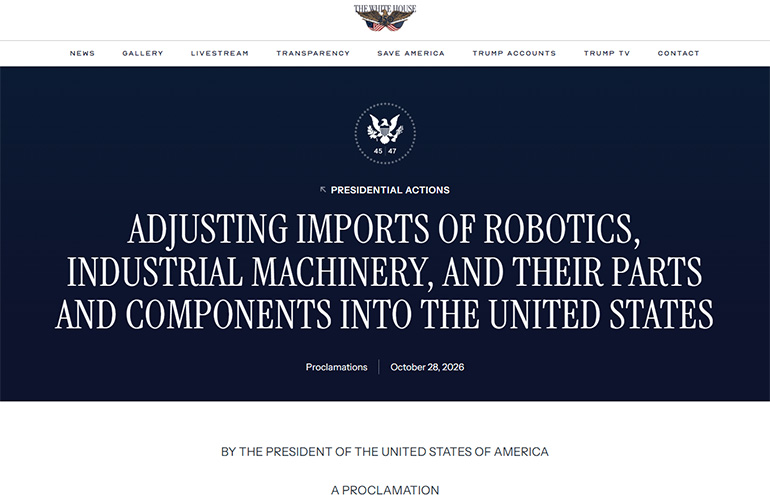
White House makes Section 232 decision regarding foreign-made robots
A Section 232 investigation by the Secretary of Commerce found that robotics imports pose a threat to U.S. national security and economic competitiveness. Source: White House Office
Yesterday, US President Donald J. Trump issued a proclamation stating that the Secretary of Commerce has submitted a Section 232 report on the national security effects of imports of robotics and industrial machinery, as well as related parts and components.
“Based on the facts considered in that investigation, and taking into account the close relationship between the economic well-being of the Nation and our national security and other relevant factors, see section 232(d) (19 USC 1862(d)), the Secretary has found and informed me of his opinion that robotics, industrial machinery, and components thereof are being imported into the United States in such quantities and under such circumstances that they threaten to impair the national security of the United States,” the president said.
“Robotics and industrial machinery are critical to virtually all modern manufacturing processes, including defense, commercial and dual-use,” he noted. “Additionally, robotics and industrial machinery generate substantial economic value and support important economic activity, including approximately $7.1 trillion in manufactured shipments in 2024 and equipment production worth approximately $86 billion in 2024.”
From mission-critical military and law enforcement activities to critical infrastructure sectors such as agriculture, automotive and electronics manufacturing, the U.S. government has stated that robots and related systems are vital to U.S. competitiveness. According to the Trade Minister, the value of such imported systems has grown over the past decade, as the cybersecurity risks have also increased.
The Section 232 statement specifically cited “advanced robots – such as autonomous robots, humanoid and quadrupedal robots, and autonomous ground vehicles” as directly supporting the U.S. military.
While investment in U.S. robotics manufacturing capacity has increased, it is not enough to meet U.S. demand, the president said. He directed the secretary and the U.S. trade representative to “enter into negotiations with trading partners to adjust imports of robotics, industrial machinery, and their components so that such imports do not threaten to compromise the national security of the United States.”
Will this Section 232 decision lead to tariffs on foreign-made robots? Given that most major industrial automation suppliers are based overseas, it remains to be seen how trade negotiations will go. The threat from geopolitical rival China is motivating policies like this investigation and the FCC’s recent restrictions.
Propose your innovation now!
Experts expect negotiations on Section 232 before any tariffs
Industry leaders and observers offered initial reactions:
“As I articulated last week [a] panel al Arrow RoboBusiness in Santa Clara Regarding the FCC action, this is another strong sign of government support for those working to develop and expand domestic supply chains for robots,” Brendan Schulman, vice president of policy and government relations at Boston Dynamics, posted on LinkedIn.
He noted that the Special Competitive Studies Project (SCSP) Commission on Robotics has achieved similar results.
“The next step for the federal government? Negotiations over the next six months with trading partners to adjust imports, and then further consideration of other trade policy measures,” Schulman added. “I am very pleased to see that robotics is gaining more and more attention and importance as one of the foundational technologies that need broad policy action and support from the US government. More to come, I’m sure!”
Robert Little, former head of robotics strategy at Novanta Inc., winner of the 2026 Joseph F. Engerlberger Robotics Award and business development consultant, agrees. “Robotics is critical for any country rebuilding its manufacturing. I wonder: why has it taken so long to make it a priority?” he said The robot report.
“Production of industrial robots is still limited in the United States today,” Little said. “FANUC, Teradyne Robotics and Yaskawa have already announced investments to expand robot manufacturing in the United States. I expect more to come and hope this new announcement will help accelerate that.”
“However, what concerns me most are the gaps in our domestic supply of components for robotics and industrial machines: sensors, actuators, precision gears, encoders and more,” he noted. “We need a much stronger U.S. supply base for these components. This is where we need help most to strengthen America’s manufacturing capacity.”
The Section 232 investigation doesn’t mean tariffs will be immediate, added Ash Sharma, vice president of research and chief information officer at Interact Analysis. “This should not be read as a new tariff on robotics today, but it is a clear indication of the direction of travel,” he said.
“The US government has explicitly identified its reliance on imported robotics and industrial machinery as a national security concern and is seeking to bolster domestic manufacturing,” Sharma commented. “If tariffs, quotas or other trade measures follow, they could have significant implications on supplier competitiveness, pricing and the location of manufacturing in the United States, potentially affecting not only finished robots, but [also] the components that compose them.”
The robot report expects more answers which will be shared in subsequent coverage.
Speakers discussed reshoring and policies such as the Section 232 investigation at RoboBusiness 2026. Credit: Arrowfly












Post Comment