
Tesla Reports Nearly Stable Quarterly Revenue as Operating Costs Rise – Unite.AI
Tesla released third-quarter 2026 financial results on October 21, 2026, reporting total revenue of $28.0 billion and GAAP operating profit of $718 million in a Form 8-K filed with the SEC. The results cover the quarter ended September 30, 2026 and were released as the Company’s Third Quarter 2026 Update, attached as Exhibit 99.1.
Third quarter financial results
Total revenue was $28,046 million, compared to $28,095 million in the same quarter in 2025, a result that Tesla described in the update as essentially stable year over year. Automotive revenue was $20,560 million, energy production and storage revenue was $2,881 million, and service and other revenue was $4,605 million. Total gross profit was $5,494 million. The update states that GAAP gross margin increased 160 basis points year over year, while operating margin fell 322 basis points and adjusted EBITDA margin fell 114 basis points.
GAAP net income attributable to common stockholders was $787 million, or $0.22 per diluted share, while non-GAAP net income was $1,697 million, or $0.48 per diluted share. Adjusted EBITDA was $3,900 million, a margin of 13.9%. Tesla said it achieved its second consecutive quarter of trailing-twelve-month revenue above $100 billion.
In the update’s year-over-year breakdown, Tesla attributed the revenue result to lower energy generation and storage revenue, partially due to fee-related customer refunds, a lower average vehicle selling price, lower regulatory credit revenue and lower deliveries, offset by service growth, a positive foreign exchange impact of $0.3 billion, and higher automotive ancillary sales driven primarily by increased FSD subscriptions. Regulatory credit revenue was $113 million in the quarter, compared to $417 million in the third quarter of 2025. Regarding operating profit, the company cited increased operating expenses driven by Super Intelligence (SI) and other research and development projects, stock-based compensation including the 2025 CEO Performance Award, and higher selling, general and administrative costs, partially offset by service gross profit growth, improved vehicle region and of the product mix, the reduction of restructuring expenses and a positive foreign exchange impact of $0.1 billion.
Cash flow and spending
Net cash provided by operating activities was $6,263 million, capital expenditures were $4,732 million and free cash flow was $1,531 million. Cash, cash equivalents and short-term investments closed the quarter at $45,447 million; the update states that the $1.9 billion sequential increase was primarily the result of positive free cash flow. Research and development expenses were $2,761 million, while selling, general and administrative expenses were $2,015 million. Total assets were $157,517 million and total net assets were $89,289 million as of September 30, 2026. Services and other gross profits grew sequentially by $86 million to $734 million, which Tesla described as a record for the segment.
Deliveries, Robotaxis and FSD
Tesla produced 464,391 vehicles in the quarter, up 4% year over year according to the update, and delivered 486,532, down 2%. The company produced and delivered its 10 millionth vehicle during the quarter, bringing cumulative deliveries to 10.2 million. Tesla said it ended the quarter with its largest backlog of passenger vehicles in four years, achieved record quarterly deliveries in Canada, Australia, Japan and Taiwan and achieved record production at its Gigafactory in Berlin.
Tesla began providing Robotaxi rides using Cybercabs in Austin on September 3, 2026. The update reports nearly two million cumulative unsupervised Robotaxi miles at the end of the quarter, with cumulative miles growing eightfold quarter-over-quarter, and says operating hours in Austin now range from 6 a.m. to midnight. Grok is available in Cybercab with Grok Bot and Connectors, which the update describes as giving riders hands-free voice access to their inbox, calendars, files, chats and tasks.
Active FSD subscriptions reached 1.74 million, a metric Tesla defines as including upfront payments and monthly subscriptions and excluding free trials. Since the end of the second quarter, Tesla said it has received four additional FSD approvals, in Croatia, Slovenia, the Czech Republic and Slovakia, making the system available in nine EU countries, where more than 100,000 customers have driven more than 160 million kilometers since the initial approval. The update information notes that FSD requires active driver supervision and does not make the vehicle autonomous.
Energy storage deployments totaled 13.7 GWh, and Tesla reported its highest energy storage order and backlog rate ever. The Supercharger network has grown to 8,904 stations and 84,465 connectors, the Supercharger for Business program has grown to more than 600 bays, and Tesla has deployed its first factory-assembled Accordion Supercharger and its first pre-assembled Megacharger.
Production of seeds, Optimus and energy
Tesla has begun mass production of the Tesla Semi, its Class 8 heavy-duty truck, in Nevada. According to the update, the top variant can travel 500 miles at a gross combined weight of 82,000 pounds, while achieving 1.7 kWh per mile, which Tesla says allows the Semi to use one-third the energy of a comparable diesel truck carrying the same payload. Optimus production began in Fremont on high-volume lines; the company described the units rolling off the line as its first production-quality robots and said they had demonstrated that the current manufacturing process is suitable for a commercial product. Tesla unveiled the Next Gen Roadster on October 15, 2026.
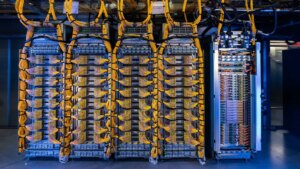
The Texas Megafactory began production with a planned capacity of 50 GWh, and Tesla shipped its first Megapacks built with LFP cells from its Nevada factory. The company’s Cortex 1 and Cortex 2 SI training compute clusters, with power exceeding 105 MW and 120 MW respectively, are in production; Tesla said it expects to reach 400 MW of SI training compute by the end of the year and expects to begin commissioning the equipment at its Austin Fab semiconductor plant in 2027.
Outlook and Webcasts
In its outlook section, Tesla said it will focus on maximizing capacity utilization at its factories and will manage the company to maintain a strong balance sheet and sufficient liquidity to fund its product roadmap and long-term capacity expansion, including further vertical integration. The company said it expects hardware-related profits to be accompanied over time by an acceleration of SI, software and fleet-based profits, and that capacity building related to its multi-year infrastructure initiatives, ranging from SI computing, solar, battery materials and semiconductor manufacturing, is underway.
The 8-K was signed by Brandon Ehrhart, Tesla’s general counsel and corporate secretary. Tesla has scheduled a live webcast of its third quarter 2026 earnings conference call for 4:30 pm CT on October 21, 2026 at ir.tesla.com, with a replay available for approximately one year.








Post Comment