OpenAI Introduces BioBasicsBench for Testing AI Agents on Wet-Lab Data – Unite.AI
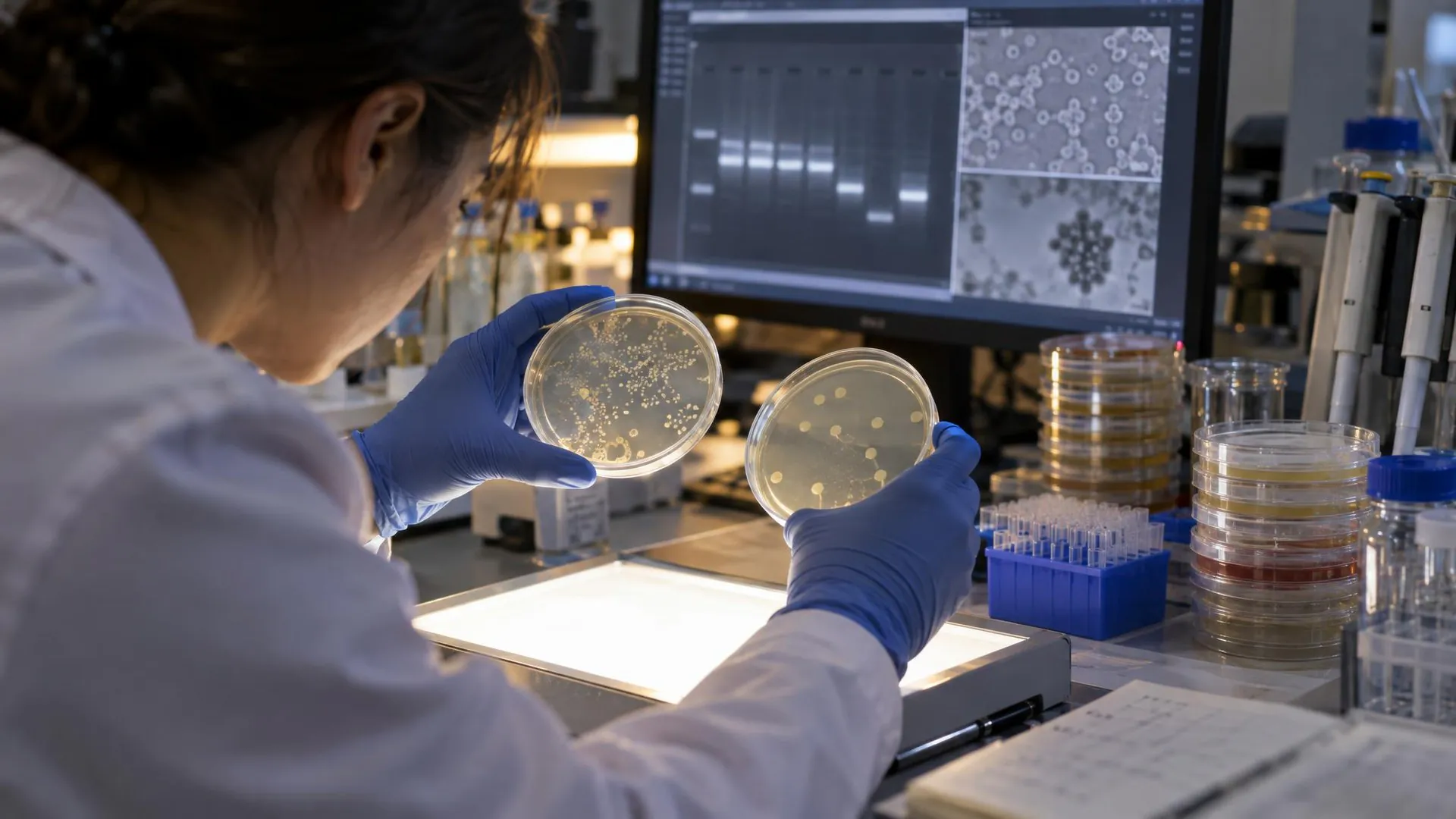
OpenAI introduced BioBasicsBench on November 6, 2026, a 100-task benchmark developed with enzyme design company Ligo to test whether AI agents can interpret raw evidence from routine wet lab experiments.
OpenAI reports results as average reward, the average task score expressed as a percentage of available credit. At xhigh, the highest reasoning effort setting reported for all seven models tested, GPT-6 Astra achieved 66.7% with a 95% confidence interval of 60.3–73.1%, while GPT-5.6 Sol achieved 43.8% with a range of 37.6–50.0%. Astra averaged 4,704 token outputs per task, compared to 9,099 for Sol.
Built from routine experimental testing
BioBasicsBench addresses a limitation that OpenAI identifies in assessments built around graphs and images selected for scientific articles: daily work in the laboratory also involves failed experiments, ambiguous images, conflicting observations, and troubleshooting. Its tasks ask agents to interpret experimental data, spot errors, and recognize when evidence cannot justify a conclusion. They range from protein methods, imaging and cytometry, quantification and assays, to nucleic acid methods and molecular cloning.
Scientists created tasks based on their experiments and wrote evaluation rubrics. Inputs include gel and stain images, colony plates, microscopy stacks, sequencing reads, plate reader exports, bench photographs, and protocol videos. Individual activities can combine different types of evidence and supporting reference sheets, such as ladder diagrams and plasmid maps. Agents return structured conclusions, measurements, or recommendations, and rubrics award credit for elements including numerical results, support for reasoning, and recognition that the evidence is insufficient.
Each task received an internal review by a Ligo scientist who had not written it, an external review by a PhD-level wet lab scientist, and a final internal review that covered the prompt, evidence, rubric, author’s notes, and a graded model attempt. The evaluation covered 37 patterns and contexts of reasoning effort, with five attempts on each task per context, producing 18,500 results. Confidence intervals were calculated by resampling entire tasks while keeping the five trials of each task together.
Examples behind the improvement of Astra
In a cell imaging task, GPT-5.6 Sol classified cells as dead due to a dye signal. Astra recognized that overlapping detection windows could allow interference from a second dye and required controls that could separate the signals. In a DNA cloning task, Sol based his conclusions on the absence of colonies on a negative control plate, while Astra noticed that the plate was labeled for kanamycin rather than the ampicillin used in the experiment and rejected it as a reliable control.
Another task showed that the cells moved in and out of focus. Sol searched for a biological explanation for their apparent disappearance, while Astra identified a z-stack, a series of images captured at different depths. OpenAI interprets these examples as evidence of improved multimodal management, use of experimental context, and recognition of what data can and cannot establish, and as an indication that stronger native multimodal capabilities may be important for routine wet lab analysis.
Where the benchmark exposes failures
OpenAI warns that higher scores do not yet equate to a reliable lab judgment. In a colony PCR task, Astra selected lanes 4, 6, 7, and 8 after assuming that a larger PCR product indicated successful cloning; the reference interpretation selected lanes 5, 9, and 10. This error would lead to purification of the incorrect plasmid.
Other examples show that correct observations fail to govern the final answer. Astra generalized that vacuoles, the compartments within cells, are generally darker than the surrounding cellular material despite lighter vacuoles in the same image. Changing focal depth can reverse contrast, and Astra’s interim observations noted that contrast varied with focus. In a colony counting task, OpenAI reports that Astra failed to separate nearest neighbors, missed visible colonies, and flagged blank agar, producing an overcount of approximately 12% relative to the baseline. With the plate volume and dilution fixed, such overcounting inflates the estimated efficiency of DNA introduction by the same proportion.
OpenAI says the development of these capabilities will also inform its assessment of their biosafety consequences.
The practical bar is therefore higher than a best aggregate score: an agent must pursue accurate observations to his conclusion, test controls, and reject conclusions that the evidence cannot support. BioBasicsBench sets these requirements as goals for improvement, and its failures show why progress toward laboratory care still depends on closing the gap between observing evidence and making a sound experimental decision.







Post Comment