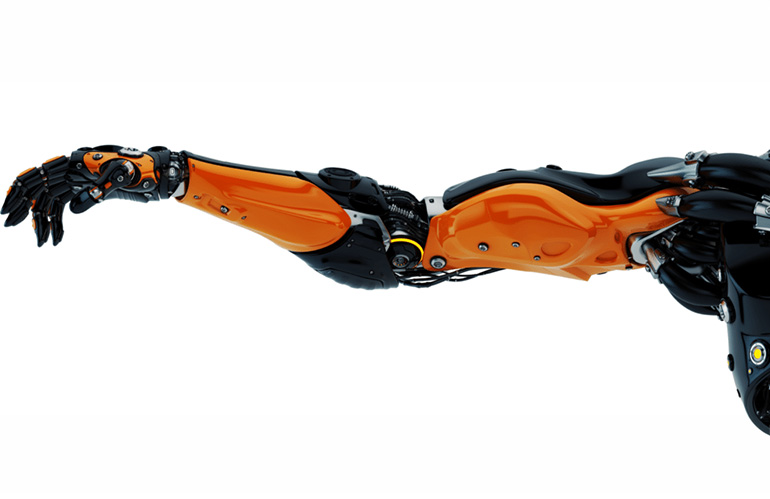
Timken Precision Drives puts the challenge of motion first in humanoid robots
Timken Precision Drives offers a portfolio of motion technologies for humanoid developers. Source: Timken, Shutterstock
What should your humanoid robot’s motion system do?
For engineers developing humanoids, the answer involves balancing torque, speed, rigidity, weight, positioning accuracy, and available space. Each joint has its own needs, and the right solution starts with understanding those needs.
That’s the approach behind Timken Precision Drives, part of The Timken Co. Bringing together Cone Drive, SPINEA, CGI Motion and Timken Encoders, the platform combines specialized engineering expertise and complementary technologies to help customers solve their motion control challenges.
The conversation begins with the question: what movement is necessary? What loads must the system support? Where does the current design fall short? And what needs to be changed to achieve the desired performance?
Timken engineers take care of the application
Humanoid developers face several challenges between load-bearing joints, compact wrists, end effectors, and other movable assemblies. A system that meets the needs of one mechanism may require a different approach in other parts of the robot.
Timken Precision Drives said it works with customers to evaluate those requirements and identify an appropriate path forward. This may involve a standard component, a modified design, or a custom solution that brings together multiple technologies.
Understanding the application early allows engineering teams to consider how gears, motors, bearings and position feedback will interact within the available space. It also helps guide decisions regarding gear ratio, load capacity, allowable deflection, duty cycle and service life.
Register now and help us celebrate 20 years of RoboBusiness!
Complementary technologies, customized possibilities
Timken said the breadth of its platform gives engineers multiple ways to tackle a motion challenge.
Cone Drive brings its strain wave gear expertise to applications requiring compact packaging, high torque density and backlash-free positioning. Component and housed configurations provide a foundation for application-specific designs, with opportunities to explore further integrations based on customer requirements.
SPINEA offers cycloidal gears and integrated actuation expertise. TwinSpin gearboxes and DriveSpin servo actuators offer options for applications where torsional rigidity, torque transmission and load handling capability are important design considerations.
CGI Motion adds precision planetary and microgears, along with custom design and manufacturing capabilities for compact mechanisms. This experience supports the exploration of motion solutions where size, configuration and performance requirements require a tailored approach.
Timken Encoders complements the mechanical portfolio with magnetic position feedback technologies, including absolute and incremental options.
Timken Precision Drives said these combined capabilities allow it to look across technologies as it works with customers to develop solutions based on their specific motion needs.
The Timken platform brings together motion technologies from multiple units. Source: Timken Precision Drives
Collaboration from concept to production
According to Timken, custom development begins with a clear understanding of the problem.
A customer may need to reduce the size of an assembly, improve positioning accuracy, increase rigidity, or integrate feedback into an existing design. Timken Precision Drives said it brings application engineering and specialized product expertise to those discussions, supported by Timken’s global engineering and manufacturing resources.
The goal is to work alongside the customer to determine which combination of technologies and design choices best suits the application, whether refining an existing mechanism or developing something new.
Bring your motion challenge to Timken precision drives
Timken Precision Drives plans to exhibit at the Humanoids Summit Silicon Valley on December 1 and 2 at the San Mateo County Event Center.
Visitors to the company’s booth can explore the platform’s motion technologies and discuss design challenges with the team. Bring requirements, integration questions, or the humanoid problem you still need to solve.







Post Comment