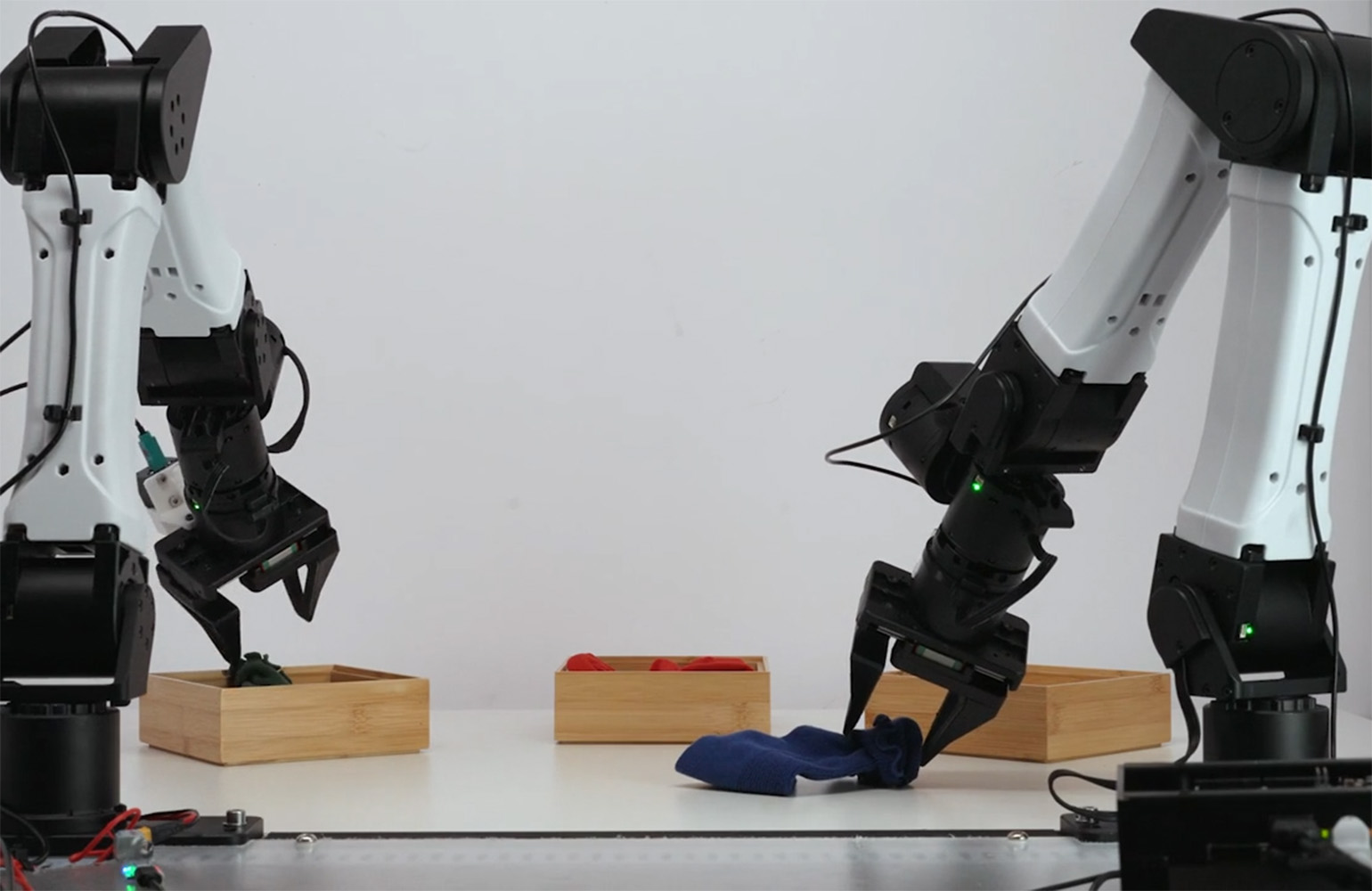
Runway’s Praxis-1 World Action Model for Robotics is now available
Praxis-1 builds on Runway’s work as a founding member of the Cosmos Coalition, developing open world models for physical AI. | Source: track
Runway AI Inc. yesterday released Praxis-1, its global action model for robotics. The model is now available to developers with open weights under the Apache 2.0 license.
Runway first announced Praxis-1 in September with launch partners including Noble Machines, Standard Bots and Ultra. Since then, these companies have run the model on their own hardware, including a legged humanoid, a six-axis industrial arm, and a dual-armed warehouse robot.
“A strong base model goes a long way. Previously, with Noble Machines, our previous model needed a lot of training to learn the warehouse task: picking up wooden planks one at a time and placing them in a container,” said Andy Chen, Runway’s head of robotics The robot report. “Praxis-1, built with more calculations and data, learned everything from half an hour of examples and got it right 15 out of 15 times. Then we gave it a messy pile of boards it had never seen thrown into bins, and it cleaned up the entire pile six out of 10 times.”
“Iterating on partner feedback improves our models,” he continued. “Today, Praxis-1 is the #1 global action model in NVIDIA’s RoboLab ranking and the #1 end-to-end open source policy.”
Praxis-1 is available on GitHub, on Hugging Face with native LeRobot support, and in vLLM-Omni, with inference hosted on Reactor. Runway said it has released everything developers need to run and adapt the model on their own hardware under Apache 2.0, including for commercial use. This covers weights, inference and tuning code, with support for both full tuning and low-rank adaptation (LoRA).
Praxis-1 works out of the box on all NVIDIA hardware, from data center GPUs like the H100 and B200, to workstation GPUs like the RTX 5090 and RTX PRO 6000, to Jetson Thor on the robot itself.
Praxis-1 is based on Runway’s video base templates
Praxis-1 is a diffusion transformer with an expert blend of 27 B parameters that features video and action together.
On RoboLab-120, Praxis-1 achieved 46.2% success in 1,200 episodes, compared to 42.9% for FLUX 3 Action, 36.8% for Cosmos3 Nano, and 28.0% for π0.5. It ranks fifth overall in the rankings.
“The bottom line is that a model trained to predict videos really understands a lot about the physical world: how objects behave, how hands move, what a task looks like halfway through, and so on,” Chen said.
“Praxis-1 builds on Runway’s basic video model and learns how the world works before it learns to take action,” he added. “We keep the video prediction in the training goal all the way through, so the model imagines what the next scene should look like and produces the motion that gets it there.”
Praxis-1 works with different embodiments of the robot
Praxis-1 learns how objects behave and tasks perform from large-scale videos. | Source: track
Praxis-1 learns how objects behave and how tasks perform from large-scale videos, which gives it a head start on a new incarnation before fine-tuning any hardware or domain-specific data, Runway explained. The company’s research has shown that web videos match videos of teleoperated robots as pre-training data for policy implementation, which shifts the bottleneck on effective policy on how much general video a model can learn from.
“The tasks vary with the robot. Noble Machines builds a legged humanoid for heavy industrial handling, and with it Praxis-1 collects wooden planks, places them in containers and cleans up the mixed piles in the containers,” Chen said. “Standard Bots makes six-axis arms for factory work like machine tending and palletizing. Ultra builds and deploys dual-arm stations that pack orders in warehouses. A humanoid, a single arm, and a pair of arms are very different machines, and the same model drives all three.”
“With our partners, a single Praxis-1 checkpoint has adapted to a variety of embodiments with light tuning, and with LoRA you can adapt it to your embodiment, cameras and tasks without retraining the complete model,” Runway said. “Refined on Google’s RT-1 robot, which never appeared in its training data, Praxis-1 achieves 80.0% success on SimplerEnv, well above the original RT-1 policy of 52.4%.”
Propose your innovation now!
Why keep Praxis-1 at open weight?
Runway has been committed to shipping the Praxis-1 as an open weight model since its initial announcement. According to the New York-based company, open weights give hardware developers the flexibility to run, inspect and adapt a world action model to their own conditions.
“We at Runway believe that U.S. leadership in physical AI is critical,” Chen said. “Regaining our global leadership in manufacturing, accelerating productivity across our economy, and protecting ourselves and our allies will depend on it.”
“Achieving this will require a significant increase in investment in both hardware and software, but will also require a level of interoperability and openness compared to American models that does not currently exist for physical use cases,” he said. “We see open-world models as a cumulative advantage that gives hardware developers flexibility and control that they currently lack.”
After making Praxis-1 available to developers, Runway said it is focusing on scaling deployments.
“We want Praxis-1 in the real world: in real warehouses, factories and industrial sites, doing real work,” Chen said. “We believe that the frontier of robotics will be discovered through real-world applications, not in a lab. Then, what comes next is implementation with our partners, learning from what the model encounters out there, and putting those lessons back into the model.”











Post Comment