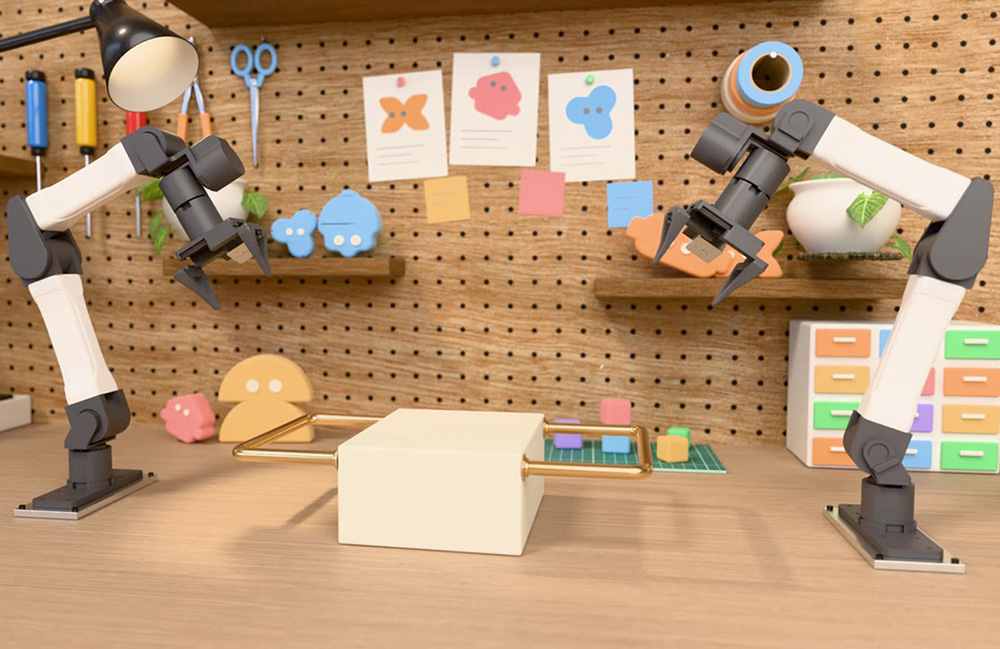
Dream Labs raises $90 million and launches Dream API
Dream Labs said its models learn how the physical world works from videos and can control new robots without any data. | Source: Dream Laboratories
More brains for robots are coming. Dream Labs this week said it had raised $90 million in seed funding. The company also launched Dream API, a publicly available application programming interface for turning a robot’s camera feed and plain English instructions into motor commands, even for never-before-seen robots.
Factories around the world operate a record 5 million industrial robots, but nearly all are programmed for a single task and most are unable to transfer what they have learned to other machines, Dream Labs noted. Low-cost robots now sell for a few thousand dollars but ship without built-in intelligence. Teaching a robot a task can take specialists months, and a new task or new hardware often means starting from scratch, according to the San Francisco startup.
Dream Labs said its flagship Dream-1 model works with robots from several manufacturers. Trained on videos of people carrying out everyday tasks, it can predict what will happen next and determine the robot’s resulting action. Because it learns from video rather than from a single machine, its capabilities transfer across all hardware, Dream Labs said.
The company said Dream-1 can control any robot “out of the box” with grippers and zero-shot learning.
“The hardware is ready. What’s missing is a brain that any robot can use,” said Joel Jang, co-founder and CEO of Dream Labs. “When you get into a rental car, you don’t relearn how to drive. You find the controls and your past driving experience does the rest.”
“Dream-1 approaches a new robot the same way, so a new robot can do useful work in minutes, not months,” he added. “And instead of modified demos, we’re giving people a working model that they can test themselves, including errors.”
B Capital and Kindred Ventures led the round. It also included participation from A.Capital, Unusual Ventures, SV Angel, Wing VC, Scribble VC and Adrian Aoun, among others.
Within the Dream Labs product portfolio
Robot developers and enthusiasts can start using Dream Labs AI products today. The company said Dream API translates visual inputs and natural language instructions directly into robot actions.
Developers can register, connect any robot with grippers, and the robot will perform the task. Dream Labs runs its models in data centers around the world, so robots respond quickly wherever they are.
The company also offers tuning as a service. For unsupported hardware or new features, robot developers and manufacturers can submit a small batch of demo data to receive a tailor-made model within hours.
Developers also have access to Dream Labs’ robot playground. Anyone with a browser can type commands into a robot in Dream Labs’ San Francisco office and watch it respond live and unchanged, with no robot purchase required.
“A powerful robotic arm has gone from the price of a luxury car to the price of a high-end laptop. What it needs now is intelligence,” said Daisy Cai, general partner at B Capital. “This team has done some of the seminal work in robot learning at NVIDIA. Now anyone with an API key can build on it.”
Startup collaborates with more than 20 hardware partners
Dream Labs today supports robots that cost between about $2,000 and $10,000. Dream-1 does not need additional data to control a two-arm robot with parallel grippers.
For its more than 20 hardware partners, Dream Labs said it goes beyond that baseline, fine-tuning the model for each robot so it works best. Dream-1 currently handles tabletop tasks such as picking and placing objects and folding laundry, with the support of mobile robots on wheels and dexterous hands to follow.
The company said it plans to use the new funding primarily for computing as it expands the tasks and robots the Dream-1 can handle and scales to support more users.
“Our customers buy our robots to build things, and the hardest part has always been getting them to do actual work,” said Ryan Chan, co-founder and CEO of MakerMods, which sells $2,000 bimanual robotic arms. “With Dream-1, our robot was up and running in minutes and performing tasks we had never planned. We can focus on building better hardware, and our customers get ever-improving intelligence.”
Register now and help us celebrate 20 years of RoboBusiness!









Post Comment