LiberAI unveils Liber-0, a global action model that grounds human experience in robot action
LiberAI introduces Liber-0, a world action model pre-trained on over 2.2 million hours of human experience to support zero-shot robot manipulation. In an evaluation of 60 tasks proposed by GPT-6, it achieved 36.0% overall success with no robot demonstrations collected specifically for those target tasks. The model combines large-scale human video, glove-recorded hand motion, and embodiment alignment to transfer human manipulation experience to robots.
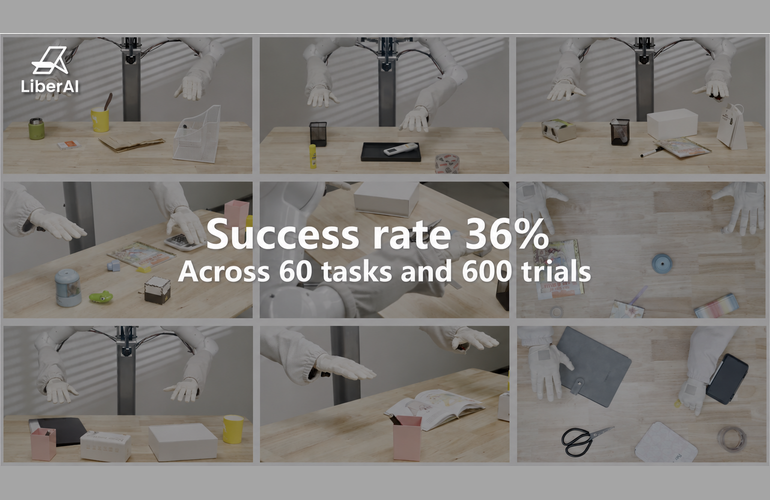
Liber-0 achieves 36.0% overall success in a zero-shot evaluation of 60 tasks proposed by GPT-6.
LiberAI introduced Liber-0, a world action model (WAM) pre-trained on over 2.2 million hours of human experience. The Beijing-based startup said the model combines human videos with recorded movements with gloves and embodiment-conditioned learning to transfer human manipulation experience to robots.
A central test of Liber-0’s generalization is whether it can perform target tasks without robot demonstrations collected specifically for them. LiberAI evaluated the model on a separate suite of 60 tasks proposed by GPT-6, distinct from its internal scalability benchmarks: 20 pick-and-place (PnP) tasks, 20 non-PnP manipulation tasks, and 20 challenging non-PnP and long-horizon tasks.
Examples from the suite include placing a pen in a pencil case, closing a drawer, and a longer sequence in which a pen is inserted into a pencil case and the pencil case is placed in a drawer.
LiberAI reported task success rates of 63.5% on pick-and-place tasks, 34.0% on non-pick-and-place manipulation tasks, and 10.5% on challenging non-pick-and-place and long-horizon tasks, with an overall success rate of 36.0% across 600 trials.
In this case, zero-shot means that the evaluated checkpoint was not trained on robot demonstrations collected specifically for these target tasks; the pretraining still included the robot’s data.
Why learn from people?
Robot manipulation traditionally relies heavily on recorded demonstrations of a specific robot for a specific task, usually by a human operator who teleoperates the machine. This data closely matches deployment, but collecting it can be slow and expensive, particularly when new tasks or robotic platforms require additional demonstrations. Human activity is much more abundant, and much of it is already on video.
The obstacle, according to LiberAI, is that human videos do not translate directly into robotic commands. Cameras are placed in different locations, hand poses estimated from videos are noisy, and human bodies move differently from robots.
Liber-0 connects human experience with robot action in three ways. First, LiberSense Glove, LiberAI’s data collection system, directly records hand movements, helping to link human videos to the movements behind them. Second, LiberAI’s robotics platform uses camera views and hand, wrist and waist movements that more closely match those of humans, making skills easier to transfer. Third, a unified embodiment representation provides the model with information about body shape and joint motion, so that it can adapt actions to the body performing them.
Liber-0 jointly predicts future video frames and actions. This allows it to learn from regular unlabeled videos of actions along with glove and robot recordings that include measured motion.
Human-to-robot transfer. Conceptual illustration of how human action-based recordings and visual and kinematic alignment support transfer to LEO.
Learning actions that were missing from the robot data
Glove data can also introduce missing behaviors into a policy’s robot data. LiberAI trained policies whose robot demonstrations only covered pick-and-place, while glove demonstrations included actions such as folding, pressing, and opening. Performance was measured as a progress score, a measure from 0 to 100 that attributes partial completion, in four pick-and-place and six non-PnP tasks. With robot data alone, the non-PnP progress score was 2.2. Adding glove recordings of such actions brought the score to 47.5, and to 54.6 when the glove set also included pick-and-place, close to the 56.3 obtained by a policy trained on robotic demonstrations of each action. This controlled experiment is separate from the 60-task suite: Actions appeared in the glove demonstrations but not in the policy robot demonstrations.
A quarter of the robot’s data
A separate experiment examines whether glove recordings can reduce the need for robot demonstrations. In an evaluation of eight tasks on LiberAI’s robotics platform, where the entire robot and glove pool contained an equal number of demonstrations, a policy trained on 25% of the robot pool plus 100% of the glove pool achieved a progress score of 75.6. A policy trained on 100% of the robot pool achieved a score of 72.8.
In this context, the glove recordings provided comparable performance with 75% fewer robot demonstrations. The savings apply specifically to robot demonstrations, as the mixed policy still made use of the entire glove pool. Because glove collection doesn’t require a robot at each site, LiberAI says the experience can be collected by more people, in more locations, and potentially at lower costs.
Direct evaluation of the pre-trained model
On LiberAI’s internal benchmarks, the pre-trained checkpoint achieved progress scores of 81.4 on pick-and-place and 72.3 on non-PnP tasks when evaluated directly. Post-training the robot added 2.2 and 1.5 points to 83.6 and 73.8. LiberAI said the small gain indicates that the pre-trained model already captures much of the capabilities needed for the tasks evaluated.
LiberAI has developed an interactive simulation where users can upload their own objects and watch Liber-0 manipulate them in a virtual environment. The simulation demonstrates object-level generalization: that version of the model has been post-trained on 100 hours of simulated teleoperation data and receives no additional object-specific training.
“Human videos show what people do, but not exactly how their hands move or how that movement adapts to a different body,” said Songming Liu, founder and CEO of LiberAI. “Rooting that experience in measured motion and aligning it with the robot’s body is what turns it into the robot’s capability.”
Introducing Liber-0, our world-class action model for zero-shot robot manipulation, including dexterous and multi-step tasks.
Across 60 GPT-6 tasks and 600 trials, Liber-0 achieved 36% overall success with no robot demonstrations collected specifically for those tasks:
• Pick-and-place: 63.5%
• Other manipulation tasks: 34.0%
• Challenging multi-step tasks: 10.5%The zero-shot capability extends beyond single actions to coordinated sequences.
Pre-trained on more than 2.2 million hours of human experience, Liber-0 jointly predicts observations and future actions to transform human experience into robotic abilities.
Technical blog:
— LiberAI (@liberai_robot) November 4, 2026
What is the future of LiberAI
LiberAI noted that the LiberSense Glove currently records hand poses and trajectories but not contact or force, which are important for insertion, fixation, and manipulation of soft materials. Tactile and force sensing, along with data collection across a wider range of homes, remain future research directions.
See Liber-0 in action and explore the full evaluation on LiberAI. For collaboration on models, robotics, LiberSense glove or other opportunities, contact the LiberAI team via the website.
Content sponsored by LiberAI




Post Comment