Warp Sciences emerges from the shadows to apply robotics to drug research
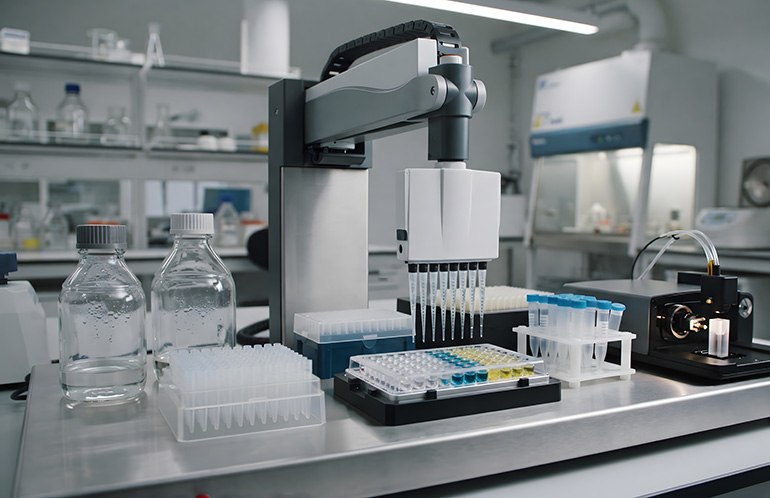
Warp Sciences plans to create a chemical infrastructure for sovereign biotechnology. Source: deni AI, Adobe Stock
Warp Sciences emerged out of the blue last week with $215 million in funding to create infrastructure that would allow biotech and pharmaceutical companies to discover new drugs faster. The startup said it is building a U.S.-based chemistry contract research organization, or CRO, to bring together chemists, robotics and artificial intelligence to create and test molecules for research groups.
The South San Francisco-based company’s stated goal is to provide experimental data to train better artificial intelligence that in turn enables more capable labs, giving scientists the ability to test more ideas.
“AI has greatly accelerated software engineering and mathematics, but has yet to have the same impact in the physical sciences,” said Kevin Weil, co-founder and CEO of Warp Sciences. “Chemistry and biology make progress when you create something, test it and learn from the result.”
“If we want to build more capable AI for science, we need to generate real-world data at scale,” he added. “Warp is starting this process by producing the research compounds that drug discovery needs today, while building the labs and automation to accelerate the cycle from hypothesis to experiment to answer.”
Warp said it does not have a proprietary drug pipeline; is designing automated labs that can run experiments, learn from them, and improve with each cycle.
Warp Sciences focuses on sovereign biotechnology
A promising molecular design is just the beginning, Warp Sciences noted. “Scientists need to build it, test it, and use what they learn to decide what comes next,” the company said. “Faster access to compounds gives research teams faster answers, more ideas to pursue, and more opportunities to find life-changing drugs.”
Warp also highlighted the importance of sovereign biotechnology. According to Reuters, in a 2024 survey by the Biotechnology Innovation Organization, 74% reported contracts with Chinese companies for preclinical and clinical services. The BIOSECURE Act, signed into law in December 2025, established a framework for restrictions on federal procurement and funding involving designated biotechnology companies of interest.
In response, Warp said it is building a U.S.-based chemical partner that scientists can rely on for its speed, quality and close collaboration. Its goal is to shorten the path from molecular design to testing, while giving customers more control over where sensitive research takes place.
The company said its initial service will focus on analog synthesis for lead optimization, making variations of molecules for scientists to compare as they search for a drug candidate. Experienced chemists will lead the experiments as the laboratory is increasingly automated by robotics and artificial intelligence, with AI models trained on data from physical experiments.
Warp plans to enable its customers to discover drugs more efficiently and to keep that discovery in the United States
Propose your innovation now!
The founders’ experience ranges from artificial intelligence to healthcare
Warp Sciences noted that its founding team’s expertise spans artificial intelligence, data infrastructure, healthcare and drug discovery. Weil most recently served as Chief Product Officer and Vice President of Science at OpenAI. Chief Science Officer Solomon “Sol” Reisberg has held leadership roles in medicinal chemistry at Terremoto Biosciences.
“I worked with foreign chemical partners who offered speed and value, but I was still concerned about protecting the intellectual property behind our programs,” Reisberg said. “We are building Warp to offer drug hunters the same level of chemical services in the United States, with intellectual property protection at the heart of the relationship and without the premium currently charged by boutique US CROs.”
Chief Technology Officer “Manohar “Mano” Paluri was vice president of Meta Superintelligence Labs and a founding member of FAIR. DJ Patil was a founding executive of Devoted Health and the first U.S. chief data scientist for the White House.
“Our goal is simple: Each experiment should make the next one smarter,” Paluri said. “AI needs a closer connection to the physical work of chemistry. Closing the loop between designing experiments, running them, and learning from their results creates systems that are increasingly capable of deciding what to do and how to do it. We are building the software, AI, and robotics together with the lab so that each part is modeled according to what chemists actually need.”
The initial hires added robotics experience from companies including Genesis, Skild AI and 1X Technologies, as well as scientific expertise from Genentech and Lawrence Livermore National Labs.
“Warp’s services strengthen customer-driven discovery programs. Our biotech and pharmaceutical customers determine which molecules to pursue and maintain control of their drug programs,” Patil said. “We’re not developing drugs on our own. We’re building the infrastructure for people to do it.”
Venture capital firms and angel investors support Warp
Lightspeed led the financing of Warp Sciences, with participation from Premji Invest, Mayfield, IVP, Lux, Conviction, Menlo Ventures, 01 Advisors, Standard, Lowercarbon Capital, Gigascale Capital, Angular Ventures, Scribble Ventures, Uncork Capital, Innovation Endeavors, Matter VP, Zero Shot Fund, SignalFire and Moxxie Ventures.
Angel investors included Brian Armstrong (CEO of Coinbase), Mike Krieger (co-head of Anthropic Labs, co-founder of Instagram), Milan Kovac (former VP of Tesla Robotics), and Ion Stoica (co-founder of Databricks). It also included Fidji Simo (former CEO of OpenAI AGI Deployment), Brendan Foody (CEO of Mercor), Mark Chen (general manager of research at OpenAI), and Sarah Friar (chief financial officer of OpenAI).
Additionally, Kate Rouch (former chief marketing officer of OpenAI and Coinbase), Lulu Meservey (CEO of Rostra), Deepak Pathak (CEO of Skild AI), Dylan Field (CEO of Figma), and Lachy Groom (cofounder of Physical Intelligence and COO) were angel investors.









Post Comment