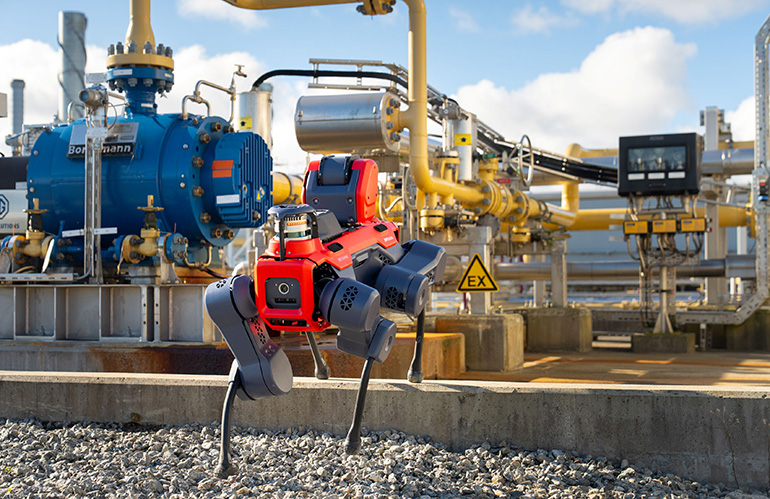
ANYbotics begins supplying ANYmal X legged robots for explosive atmospheres
ANYmal X is certified to operate in hazardous atmospheres. Source: ANYbotics
Hazardous environments are good use cases for robots, which are expanding into new use cases. ANYbotics AG today launched ANYmal X, which it calls “the world’s first legged explosive atmosphere inspection robot.”
The new quadruped is designed to meet rigorous safety standards in the oil, gas and chemical industries, the company said. ANYmal
“Four years of pioneering engineering with more than 10 patents contributed to ANYmal X,” said Péter Fankhauser, co-founder and CEO of ANYbotics. “Many experts thought that a legged robot could never be made safe for explosive atmospheres.
“Oil, gas and chemical facilities are among the most dangerous and expensive places to operate,” he added. “This makes them the leading case for physical and industrial AI, but until now the areas that matter most were off-limits to robots like ours. Today that changes.”
Born out of ETH Zurich in 2016, ANYbotics said its ANYmal robots and Shift operating platform automate routine inspections across multiple industries, keeping people out of harm’s way and turning inspection data into maintenance actions. Backed by more than $150 million from leading European and Silicon Valley investors, ANYbotics has around 200 employees in Zurich, San Francisco and Barcelona.
Equipment failures in hazardous spaces are costly, says ANYbotics
“Valued at $102 billion, the global oil, gas and chemical sector represents the largest market for autonomous inspection,” ANYbotics noted. “Two major operating costs drive this market value: the expensive skilled labor required for manual inspection and downtime caused by preventable equipment failures.”
“Because critical components, such as pumps, compressors, valves and pipelines, are located in hazardous areas, where standard robots are prohibited, human operators still need personal protective equipment, portable gas detectors and entry permits to inspect these areas on foot,” he said.
Undetected equipment failures cost the world’s 500 largest companies about $1.4 trillion each year in preventable downtime, ANYbotics said. In the oil and gas sector alone, a single hour of unplanned downtime can cost up to $500,000, according to Siemens, while U.S. mine workers face a fatality rate seven times higher than the national average, NIOSH found.
In addition to keeping workers out of harm’s way and minimizing downtime, ANYmal X can provide structured, repeatable and continuous observation data that improves digital facility planning models, such as digital twins. ANYbotics said this gives them more contextual detail to be more useful across the entire organization.
Propose your innovation now!
Certifying a robot for hazardous locations is one of the most difficult parts of the design process
Every device used in hazardous areas, from radios to flashlights, must be explosion-proof or “explosion-proof,” ANYbotics said. Each unit requires independent certification stating that it cannot ignite a flammable atmosphere, even in the event of a failure. ANYbotics built ANYmal X to comply with the ATEX standard in Europe and IECEx globally.
Stationary equipment typically achieves compliance by using heavy, explosion-proof enclosures or by limiting electrical power to prevent ignition, the company explained. A legged robot cannot use either approach. It requires high-power motors and a large battery in a chassis light enough to climb stairs, exposed cameras and sensors for navigation, and autonomous docking capability.
ANYbotics designed its legged robots for complex environments. Source: ANYbotics
Each of these components had to be certified explosion-proof without sacrificing the payload capacity, agility or operational speed of the autonomous mobile robot (AMR), ANYbotics said.
“We asked ourselves one question over and over again: What credible event in the life of a walking robot could create an ignition source, and how do we ensure it never does?” said Andrea Corda, chief technology officer of ANYbotics. “Working closely with certification bodies, we answered this question component by component. The result is a new approach to explosion protection for an entire class of autonomous mobile robots.”
ANYbotics has performed a comprehensive ignition risk assessment over the service life of ANYmal X and has implemented safeguards for each potential ignition source. Each of its components has been designed to minimize the risk of ignition.
The company said the new robot’s AI computer and inspection equipment are enclosed in sealed chambers filled with nitrogen. Nonmetallic shells insulate metal components, conductive pins provide grounding, and automatic shutoffs monitor temperature. All the actuators of the 12 legs and the relative battery are protected by fireproof casings. Charging and data transmission use energy barriers, so no connections are exposed to hazardous areas.
ANYmal X’s onboard software monitors the robot’s condition before, during and after each mission. It also tests for durability against shock, vibration, corrosion, solar radiation and salt spray to ensure that all protective measures work properly during normal use.
ANYmal
“A certified robot is just the entry ticket to inspecting oil, gas and chemical facilities,” said Thierry Obédé, chief revenue officer at ANYbotics. “ANYmal
“Today, more than 50 customers in the energy, metals and materials industries use this system to perform more than 120,000 autonomous inspections every month,” he added.
ANYmal Connect inspection results with existing plant maintenance software, including SAP, Yokogawa and SLB. To ensure high-level data protection, the entire system is developed and operated according to ISO 27001 information security standards.
“The plants operate thanks to process data from the control systems and company data from their ERP,” said Obédé. “The third source, what operators see, hear and measure during their rounds, has always been manual. ANYmal
The ANYmal X robot autonomously carries out industrial inspections. Source: ANYbotics
Industry leaders have tested ANYmal
Since 2023, energy and chemical industry leaders including BP, Equinor, Shell, PETRONAS, Petrobras, BASF and SLB have tested ANYmal X in hundreds of onshore and offshore missions through the ANYbotics Early Access Program. Their feedback helped refine the industrial-grade robot tested in the field and now delivered to customers.
ANYmal
The robot’s built-in thermal, visual, acoustic and gas sensors detect overheating, leaks, abnormal noises and equipment wear, recording each reading directly to the corresponding asset, the company said. This gives reliability engineers a standardized baseline to monitor the health of assets over time, allowing teams to spot early signs of wear and tear and intervene before minor issues turn into costly plant shutdowns.
ANYmal









Post Comment